Sia's Vintage Guitars
Tokai
Cat's Eyes (CE) 500

Homage to the Martin Dreadnought "D" Series
The Martin Dreadnought, first introduced in 1916 and relaunched by C.F. Martin & Co. in 1931, revolutionized the acoustic guitar world with its larger body and powerful projection. Named after the massive British battleships, the Dreadnought’s bold, balanced tone and strong bass response quickly made it a favourite among bluegrass players, folk artists, and singer-songwriters. Early models like the D-18 and D-28 set a new benchmark for steel-string acoustics, while the introduction of the D-45 with its ornate appointments and exceptional tonal richness, cemented the Dreadnought’s status as Martin’s most iconic and coveted body style.


1935 Martin Catalog
Pic Credit: acousticmusic.org
The Martin Dreadnought has been the go-to acoustic guitar for countless influential musicians across generations. In the early days, bluegrass legend Doc Watson and country pioneer Hank Williams famously relied on the power and clarity of the D-18 and D-28. Folk icon Bob Dylan and singer-songwriter Neil Young also made the Martin Dreadnought central to their sound in the ’60s and ’70s, with Young’s well-loved D-45 being particularly noteworthy. In more recent times, artists like Ed Sheeran and John Mayer have continued the legacy, with Mayer often turning to his vintage D-45 on stage and in the studio.


Bob Dylan
Pic Credit: liveforlivemusic.com
Paul McCartney
Pic Credit: myrareguitars.com
Jimmy Page
Pic Credit: groundguitar.com
The Tokai "Cat's Eyes" (CE) Model
In the 1970s, Tokai Gakki emerged as a key partner for C.F. Martin & Co. in Japan, becoming the sole distributor of Martin guitars in the country and officially designated as Martin’s Far East Service Center. During this partnership, Tokai began producing its own line of acoustic guitars under the name Cat’s Eyes, which were meticulously crafted replicas of Martin’s iconic dreadnaught models. These guitars were built with remarkable attention to detail—often using similar tonewoods, bracing patterns, and construction techniques—earning them a reputation for delivering “Martin-like” tone at a more accessible price. The Cat’s Eyes series has since become highly sought after by collectors and players alike, standing as a testament to Tokai’s craftsmanship and the cross-cultural legacy of the Martin Dreadnought.




1970s Tokai Cat's Eye Advertisements
Pic Credit: oldguitar.jp
Early advertisements explain that inside the Tokai guitar factory, a specialized repair room is dedicated solely to Martin instruments, where all work—from fret adjustments to finishing—is carried out to Martin’s own standards, using authentic Martin parts. The repair techniques, passed down directly from Martin craftsmen, have also been integrated into the Tokai Cat's Eye series. This shared passion for superior guitar-making has forged a strong bond of trust between the two companies. It is the strength of tradition—prioritising quality over quantity! The advertisements go on to say that "Tokai’s Cat’s Eye guitars are now widely recognised as acoustic masterpieces... a line of instruments we are proud to say embodies a deeply resonant and extraordinary sound."


1970s Tokai Cat's Eye Advertisements
Pic Credit: oldguitar.jp
This article focuses on a guitar I recently acquired - the Tokai CE-500. I love doing research on these vintage instruments, and so here is a synthesis of information from all the catalogues and websites I could access...


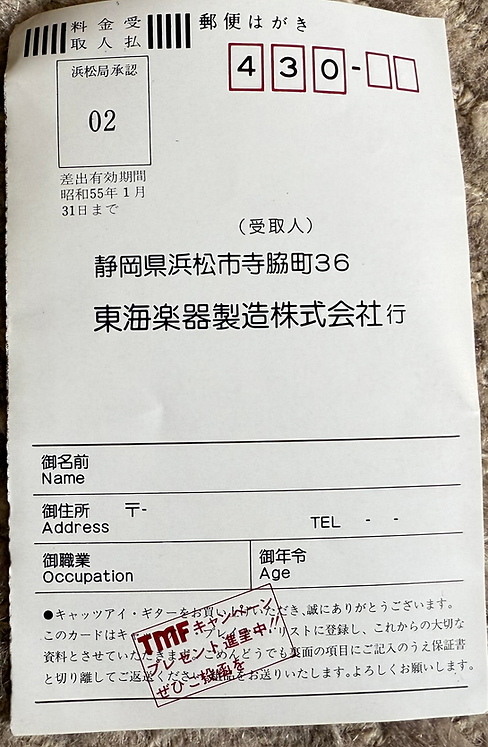

Original manual that came with my CE-500
Dating

The Cat's Eyes series were produced from the 1970s, and my particular guitar was made in 1979. The serial number ending with "79" is what gives it away.
Price


1975 Tokai Catalog
Pic Credit: Sigmania, tokaiforum.com
1979 Tokai Catalog
Pic Credit: Sigmania, tokaiforum.com
The CE-500 was priced at ¥50,000 at the time, which was about USD $220 in 1979 or approximately USD $1000 in 2025 when adjusted for inflation. For perspective, this price point placed the model somewhere in the lower-middle end of the acoustic guitar catalogue with the most expensive guitar being the CE-2500 for ¥250,000 and the least expensive being the CE-200 for ¥20,000. According to accounts by Mr. Norihiro Yoshida, who was a Tokai employee at the time, the CE150–CE300 series were regarded as mass-produced models, while the CE400–CE600 series were classified as semi-manufactured instruments. Guitars bearing a CE designation of 800 or higher were considered luxury handicrafts and were produced in separate, specialised factories.
Shape
The manual that came along with my guitar, and bears its serial number, states that "This is a reproduction of the Martin original D-45, known as the ‘legendary masterpiece,’ of which only 91 were made between 1933 and 1942." While different CE models borrow design elements from specific Martin models, the overall dreadnought shape is common across them. This shape was invented by Martin Guitars in 1916 and named after the powerful British battleship, HMS Dreadnought. Designed to be louder and more powerful than existing acoustic guitars, its larger body, wider lower bout, and deeper soundboard produced a booming, bass-heavy tone that could project over other instruments in an ensemble. This design made it popular for country, bluegrass, and folk music, and it has since become one of the most iconic and recognisable acoustic guitar shapes.
Wood


The top on this CE-500 is solid spruce, as demonstrated by the woodgrain running consistently through the top, around the edges, and through to the bottom. Lower-end Cat’s Eye models likely used laminate, but on this CE-500 the solid soundboard is a key feature. The top is often called the soundboard because it contributes the majority of an acoustic guitar’s tonal character; some luthiers estimate that as much as 80% of the instrument’s sound comes from this single component. While laminated back and sides have only a modest effect on tone, the top must be solid for optimal resonance and projection.
The back and sides on the CE-500 appear to be rosewood laminate as per my examination, because there is a mismatch between the grain pattern inside and outside. The back is decorated with a classic checkered wood marquetry back-strip, inspired by the post–World War II Style-28 Martin designs. This strip is likely a laminate of black fibre and natural, unstained light wood. The finish is a clean natural colour.
Despite its full dreadnought body, the guitar is impressively lightweight at around 2.17 kg / 4.75 lbs, which is precisely the weight of the existing Martin D-45 models.
Bridge

The rosewood bridge is fitted with traditional plastic bridge pins, each one slotted, while the saddle is crafted from bone and precisely shaped for accurate intonation.
Headstock & Tuners


The "Cat's Eyes" font is a mix of upper and lower case (unlike the all upper case font in the earliest models). The CE-500 has Grover Rotomatic style tuners. This design rose to prominence in the early 1950s as industry-leading tuners thanks to their enclosed, permanently lubricated gears, offering far better stability and precision than earlier designs. By the 1970s, they were widely regarded as a superior upgrade to the less consistent Kluson tuners, becoming the go-to choice for players seeking smoother action and reliable tuning—even though they were larger and heavier. My CE-500 has replacement "Gotoh" branded tuners, specifically the model SG-301-20-G which look almost identical to the original tuners that the guitar came with (which might have been made by Gotoh anyway). These use a 18:1 gear ratio and are exceptionally study are smooth to operate, and are considered more precise than their vintage counterpart. In the 1970s, Gotoh emerged as a top-tier Japanese manufacturer known for high-precision, technologically advanced tuners, eventually earning a worldwide reputation for producing some of the best-performing modern tuning machines available.

The angle of head stock is 12 degrees, which is quite typical for most acoustic guitars but not as steep as the Martin Dreadnought of 15 degrees. Another difference is that the CE-500 has a scarf joint at the tip of the diamond volute, instead of being a one-piece neck like the Martin guitars.
Neck & Fretboard


1975 Tokai Catalog
Pic Credit: Sigmania, tokaiforum.com


The fingerboard is bound in ivory-coloured celluloid, lending the guitar a refined vintage character. This binding does not extend over the fret nibs though. The neck features a beautifully contoured 1960s-style profile with 20 frets and is built as a traditional set neck, unlike the bolt-on construction used on lower-end CE models. It meets the body at the 14th fret, just as on the Martin Dreadnoughts it seeks to honour, and the fretboard carries a radius close to 16", consistent with classic Martin specifications. Crafted with a rosewood fingerboard and mahogany neck, the instrument also includes a diamond volute at the back of the headstock—a decorative tribute to the vintage Martin D-45. Although Martin introduced mahogany necks around 1916, which made the structurally necessary volute redundant, the feature survived on high-end models as an aesthetic hallmark, a tradition this guitar proudly continues. Completing the look, the headstock bears an ornate shell inlay, and each fingerboard inlay reflects a traditional motif, the most distinctive being the 12th-fret “cat’s eye” design that inspired the Cat’s Eye brand name, accompanied by snowflake inlays reminiscent of early pre-war Martin D-45s.
Trussrod

Interestingly, while this CE is meant to pay homage to Martin Guitars of its time, it has an improvement to the Martin Guitars of its time i.e. it has a truss rod at the sound hole. Martin introduced adjustable truss rods only in 1985, switching to the modern, adjustable design after using non-adjustable rods for many years. Prior to 1985, they had used non-adjustable steel rods, with a square tube design being common from 1967 to 1985. The CE 500 truss rod can be adjusted with a 5mm size hex Allen key, just like the modern Martin Dreadnought.
Bracing

In the mid-1800s, Martin adapted the X-bracing system for its guitars. It is excellent in both acoustics and strength, and has had a major impact on the development of not only Martin guitars, but also acoustic guitars in general. The CE-500 has this same X-bracing, as seen in the outlined image above which is based on a photograph from Tokai literature published during that time period. Also, I was surprised to find scalloping on the internal braces, as seen in the photograph of my guitar above. Scalloping refers to the careful carving of the wooden support braces into gentle, scooped curves rather than leaving them flat and heavy; this reduces weight while preserving strength, allowing the soundboard to vibrate more freely and producing a richer, more responsive tone—something typically associated with higher-end, thoughtfully voiced instruments.

Nut

The CE-500 has a bone nut, angled at the bottom like vintage acoustic Martin guitars, 1-3/4" neck width. An old Tokai catalogue says that thanks to the carefully adjusted nut width and string height, chords ring cleanly even in the higher positions, making fretting and picking feel effortless.
Pickguard

The CE-500 has a black acetate pick guard like the Martins from its time.
Case

Original manual that came with my CE-500


I have the original hard shell case for the CE-500. The manual says "This is an exact replica of the Martin Guitar case of the Good old Days.", and “Cat’s Eye sells a dedicated case for ¥13,000. The exterior of this case is a faithful copy of a Martin case from the 1940s, but the interior is designed specifically by Tokai Gakki to minimize cracking even in the event of a strong impact.”
Pickups

My CE-500 was equipped with a professionally-installed Mi-Si Acoustic Trio, a cutting-edge pickup system designed for exceptional tone and eco-friendly performance. Instead of traditional 9-volt batteries, it uses a rechargeable supercapacitor that powers up in just 60 seconds and delivers 8–16 hours of playing time.
The system pairs an active endpin preamp with an L.R. Baggs Element undersaddle transducer, producing a warm, open, and highly responsive sound that preserves the guitar’s natural voice—without the harsh, compressed character of many piezo pickups. The previous user must have been using it for some serious gigging, because the system costs about $200 plus installation!